


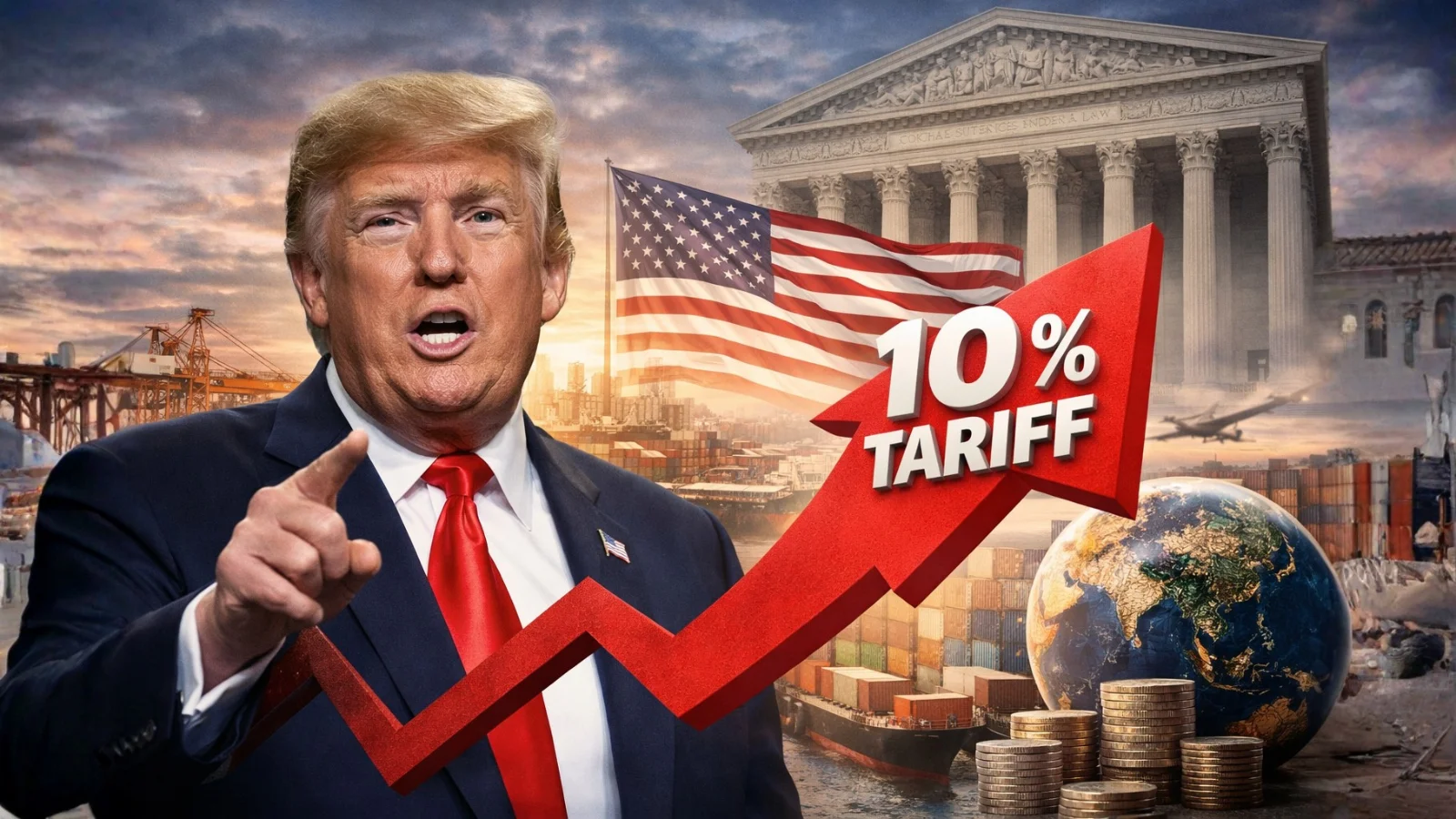
Trump’s 10% Global Tariff to Replace Duties Struck Down by US Supreme Court Setback
In a dramatic escalation of U.S. trade policy, President Donald Trump has ordered a temporary 10% global tariff on imports after the U.S. Supreme Court struck down his administration’s earlier emergency tariff regime in a landmark ruling on February 20, 2026.
The move comes just hours after the court ruled 6–3 that the International Emergency Economic Powers Act (IEEPA) — a 1977 law traditionally used for sanctions — does not authorize the president to impose tariffs, dealing a major legal blow to one of Trump’s central economic strategies.
Supreme Court Blocks Emergency Tariffs
The decision in Learning Resources, Inc. v. Trump determined that tariffs implemented under emergency economic powers exceeded presidential authority, emphasizing that the constitutional power to tax lies with Congress rather than the executive branch.
Chief Justice John Roberts, writing for the majority, rejected the administration’s interpretation of IEEPA, effectively invalidating a sweeping set of tariffs that had generated more than $133 billion in revenue and shaped U.S. trade policy throughout Trump’s second administration.
Legal analysts have described the ruling as one of the most significant checks on executive economic power in decades, raising questions about refunds for companies that paid duties under the now-invalid framework.
New Tariff Under Trade Act of 1974
In response, Trump announced that he would impose a uniform 10% tariff on all imports for up to 150 days, invoking Section 122 of the Trade Act of 1974 — a statute that allows temporary trade restrictions without congressional approval in cases involving balance-of-payments concerns or threats to domestic industry.
This authority enables the president to:
-
Impose tariffs of up to 15%
-
Apply them to any or all countries
-
Maintain the duties for a maximum of 150 days
Unlike IEEPA, Section 122 is explicitly designed for trade policy and may provide a more legally defensible basis for short-term tariff actions.
Administration officials indicated that the new tariff would be in addition to existing duties and intended to maintain roughly the same level of tariff revenue as the measures struck down by the court — albeit through a different legal mechanism.
Potential for Further Trade Measures
Alongside the temporary tariff, the White House has launched new investigations under:
-
Section 301 (unfair trade practices)
-
Section 232 (national security risks)
These probes could ultimately lead to country-specific tariffs exceeding the 10% baseline depending on their findings.
Trump has also suggested that the court’s ruling could open up approximately $175 billion in previously collected tariffs to litigation, creating further uncertainty for global businesses and trade partners.
Global Trade Implications
The shift marks a rapid recalibration of U.S. trade policy and introduces renewed uncertainty into international markets. While the Supreme Court ruling blocks the administration’s use of emergency economic powers for tariff-setting, it leaves open other statutory pathways — including the Trade Act of 1974 — that could sustain an aggressive protectionist stance.
Economists warn that the temporary tariff may strain relations with key trading partners and complicate global supply chains, even as the administration argues it will help protect domestic production and address trade imbalances.
Sources: Reuters, AP News, The Straits Times, Economic Times, Washington Post (Feb 20–21, 2026).
-
Trump pivots to new 10% global tariff, new probes after Supreme Court setback
-
Supreme Court strikes down Trump’s sweeping tariffs, sparking fierce pushback and vow of new levies
-
Trump slams justices after Supreme Court strikes down most of his tariffs
-
What is Section 122 of the US Trade Act of 1974, Trump’s latest tariff weapon
- 10 percent import tariff
- Donald Trump
- economic policy
- economic sanctions
- global markets
- global trade tensions
- IEEPA tariffs
- international economy
- international trade news
- protectionism
- Section 122 tariff
- Section 232
- Section 301
- tariff policy
- Trade Act of 1974
- trade investigations
- trade regulations
- trade war
- US economy
- US foreign trade
- US global tariff
- US import duties
- US imports tax
- US Supreme Court ruling
- US trade policy
- world trade















Leave a comment