


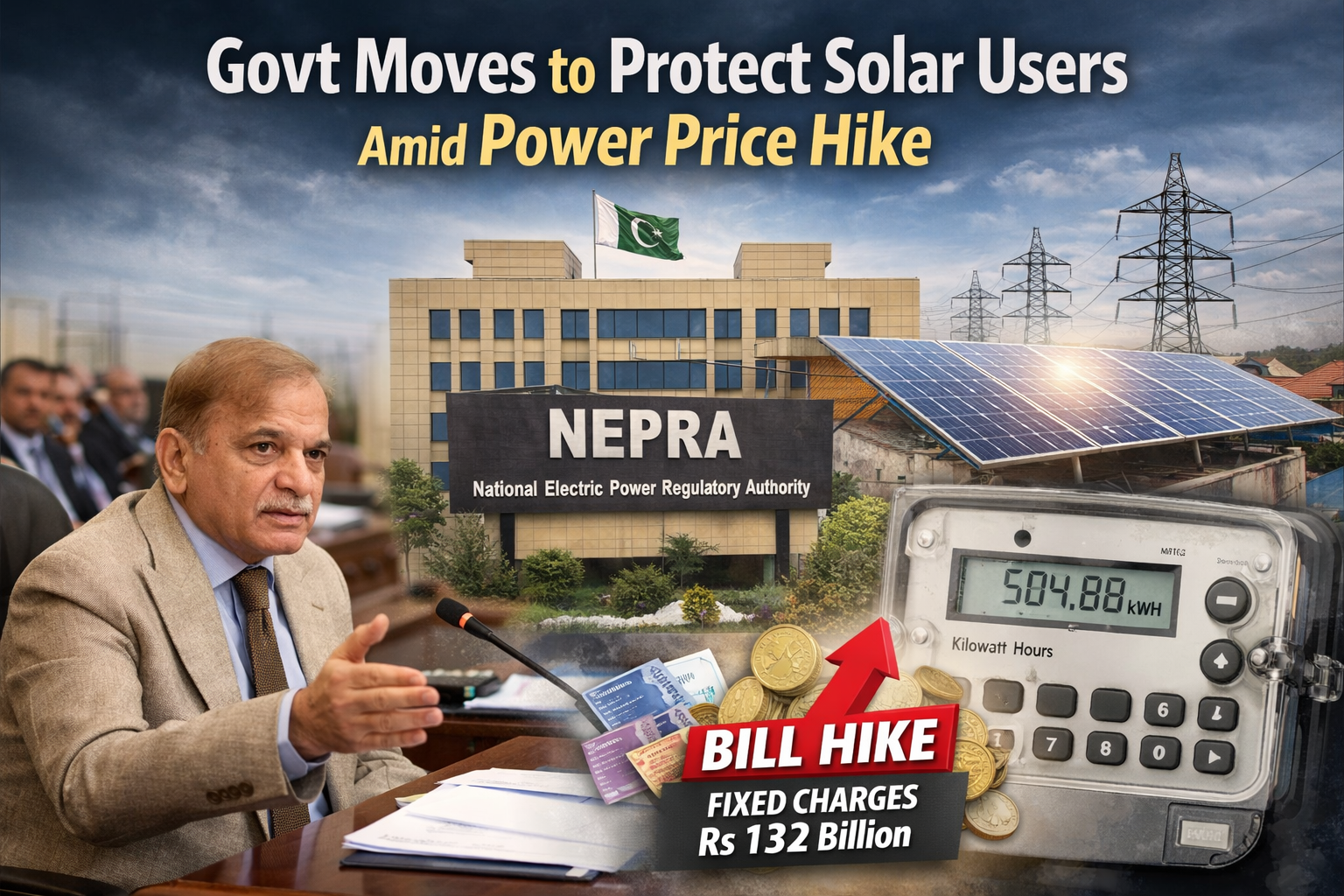
PM Shehbaz Orders Review of Solar Rules as Nepra Approves Rs132bn Fixed Charges for 28.5m Consumers
In a major development for Pakistan’s power sector, Prime Minister Shehbaz Sharif has directed the Power Division to file a review petition against new rooftop solar regulations issued by the National Electric Power Regulatory Authority (Nepra), even as the regulator approved Rs132 billion in new fixed charges for residential electricity consumers.
The twin decisions are set to impact millions of households and over 466,000 rooftop solar users across the country.
PM Intervenes Over Solar Policy Shift
The prime minister took “immediate notice” of Nepra’s revised Prosumer Regulations 2025 following criticism in the Senate from both government allies and opposition lawmakers.
Nepra had earlier revised rules for all existing and future net-metered solar consumers — known as prosumers — citing rising solar penetration and the need to protect the financially strained national grid.
What Changed?
-
Net metering effectively replaced with net billing
-
Exported solar units now credited for one month instead of three
-
Solar systems cannot exceed originally sanctioned load (capacity cut by 50%)
-
Existing contracts remain in place until their seven-year term expires
Under the new net billing model:
-
Consumers buy electricity from the grid at Rs37–55 per unit
-
Solar exports are credited at about Rs10 per unit (National Average Energy Purchase Price)
The PM directed authorities to ensure “every possible safeguard” for existing contracts, emphasizing that the burden of 466,000 solar users should not fall on 37.6 million grid consumers.
Power Minister Awais Leghari defended Nepra’s decision, stating that regulatory changes fall within the authority’s legal mandate.
Energy experts, however, warn the new framework could slow Pakistan’s decade-long growth in citizen-led clean energy.
Nepra Approves Rs132bn Fixed Charges for Households
In parallel, Nepra approved a federal government decision to impose Rs132 billion in fixed monthly charges on more than 28.5 million residential consumers.
The decision, effective retrospectively from February, significantly raises electricity costs — especially for low-usage households.
New Fixed Charges (Per kW of Sanctioned Load)
-
Up to 100 units: Rs200–275 per kW
-
101–200 units: Rs300 per kW
-
200–300 units: Rs350 per kW
-
301–400 units: Rs400 per kW
-
401–500 units: Rs500 per kW
-
501–600 units: Rs675 per kW
-
Above 600 units: Rs675 per kW
The move excludes approximately Rs24 billion in additional taxes, surcharges, and duties.
Biggest Impact on Low-Income Consumers
More than 22 million consumers in the lowest slabs (up to 100 units) face the sharpest increase:
-
Protected consumers: 76% increase (Rs8 per unit rise)
-
Non-protected consumers: 73.5% increase (Rs16.5 per unit rise)
For 101–200 unit users:
-
Increase of Rs4–6 per unit
-
Around 31% jump in average cost for protected consumers
This marks what officials describe as the largest price hike for low-consumption households since the power sector’s restructuring in the 1990s.
Why the Government Approved It
According to Nepra, the revised tariff:
-
Fits within the approved revenue requirement of distribution companies (XWDISCOs)
-
Aligns with the Rs249bn tariff differential subsidy (TDS) budgeted for 2026
-
Eliminates cross-subsidy burden on industry
Industrial tariffs will fall by Rs4.04 per unit, a move the government says will improve export competitiveness and bring cross-subsidy for industry to zero.
Who Benefits?
-
Time-of-use consumers with loads above 5kW will see an average 7% reduction after the removal of their Rs1,000 per kW fixed charge.
-
However, even they face a 6% increase in off-peak rates.
Bigger Picture: Revenue vs. Renewable Growth
Officials estimate the new fixed charges will generate Rs132bn for distribution companies — though some projections suggest the figure could exceed Rs250bn as subsidies shrink.
At the same time, solar industry stakeholders warn that restricting net metering could:
-
Discourage rooftop solar adoption
-
Slow clean energy investment
-
Increase dependence on costly grid power
With public backlash mounting, all eyes are now on Nepra’s response to the government’s review petition — and whether Pakistan’s rooftop solar boom will continue or lose momentum.
- cross subsidy electricity
- Dawn February 12 2026
- electricity consumers Pakistan
- electricity price hike 2026
- fixed charges electricity
- industrial tariff reduction
- Nepra
- net billing policy
- net metering Pakistan
- Pakistan electricity tariff
- Pakistan energy crisis
- power division Pakistan
- power sector reforms Pakistan
- residential electricity bills
- rooftop solar Pakistan
- Rs132bn fixed charges
- solar policy Pakistan














Leave a comment