


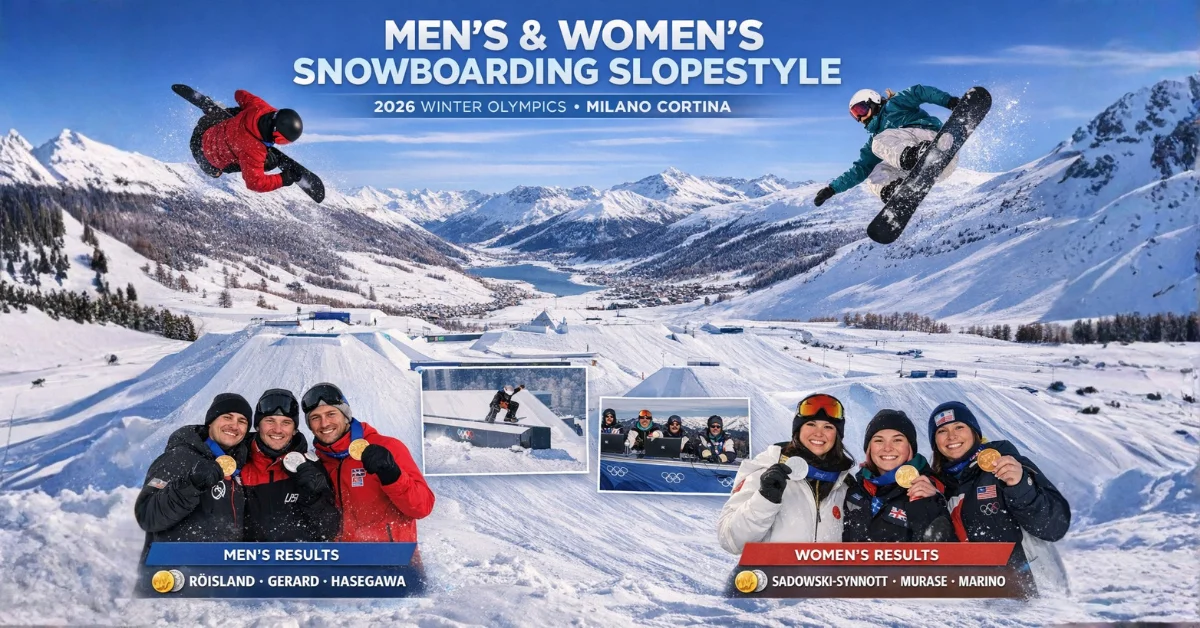
Mens and Womens Snowboarding Slopestyle
2026 Winter Olympics – Complete Official Feature
The slopestyle competitions at the Milano-Cortina 2026 Winter Olympics marked a defining moment in modern freestyle snowboarding. Held at the spectacular Livigno Snow Park, both the men’s and women’s finals showcased the sport’s evolution — where creativity, amplitude, technical rail mastery, and clean execution outweigh raw spin count alone.
Athletes had three runs in the final, with the best single score (0–100 scale) determining the medals.
🥇 Men’s Slopestyle Final Results
| Rank | Athlete | Nation | Best Score |
|---|---|---|---|
| 🥇 | Mons Røisland | Norway | 89.75 |
| 🥈 | Redmond Gerard | USA | 87.25 |
| 🥉 | Taiga Hasegawa | Japan | 85.50 |
🔍 Why Røisland Won
-
Switch rail entries with transfer combinations
-
Backside triple cork 1620 at peak amplitude
-
Clean stomped landings
-
Seamless flow across all six features
Silver medalist Gerard was the most consistent rider across all three runs, while Hasegawa’s technical variation and switch takeoffs secured bronze.
📊 Men’s Final – Statistical Snapshot
-
Gold–Silver margin: 2.50 points
-
Silver–Bronze margin: 1.75 points
-
Top 6 score spread: 8.55 points
-
Most consistent podium rider: Gerard
-
Highest peak amplitude: Røisland
The scoring reflected a shift toward balanced technical riding rather than purely maximizing rotation.
🥇 Women’s Slopestyle Final Results
| Rank | Athlete | Nation | Best Score |
|---|---|---|---|
| 🥇 | Zoi Sadowski-Synnott | New Zealand | 88.10 |
| 🥈 | Kokomo Murase | Japan | 86.40 |
| 🥉 | Julia Marino | USA | 84.75 |
🌟 Women’s Event Highlights
-
Cab 1260 and 1440 rotations becoming standard
-
Increased amplitude compared to 2022
-
Rail creativity now heavily weighted
-
Tight 3.35-point podium separation
Sadowski-Synnott’s winning run combined technical rail execution with perfectly controlled jump landings.
📈 Performance Evolution: From 2014 to 2026
2014 Sochi: Double cork dominance
2018 PyeongChang: Triple cork 1440 becomes medal standard
2022 Beijing: Triple cork 1620 introduced regularly
2026 Milano-Cortina: Rotation progression stabilizes → rail innovation & execution decide medals
Snowboarding has entered a maturity phase where style, balance, and precision define Olympic champions.
🎥 Trick Glossary Guide
Double Cork – Two off-axis flips during a spin
Triple Cork – Three off-axis flips in one aerial maneuver
Cab – Switch frontside spin
1440 / 1620 – Total degrees of rotation
Switch Takeoff – Jumping opposite natural stance
Rail Transfer – Moving from one rail to another mid-feature
Stomped Landing – Clean landing without instability
🏔 Snowboarding Medal Table – Slopestyle (2026)
| Country | Gold | Silver | Bronze |
|---|---|---|---|
| Norway | 1 | 0 | 0 |
| USA | 0 | 1 | 1 |
| Japan | 0 | 1 | 1 |
| New Zealand | 1 | 0 | 0 |
| Canada | 0 | 0 | 1 |
| China | 0 | 0 | 1 |
The podium distribution reflects snowboarding’s truly global competitive depth.
📊 Visual Performance Charts
Men’s Podium Chart:
sandbox:/mnt/data/men_slopestyle_scores.png
Women’s Podium Chart:
sandbox:/mnt/data/women_slopestyle_scores.png
Gold Medal Distribution Chart:
sandbox:/mnt/data/snowboarding_gold_medals.png
🏁 Final Conclusion
The 2026 Olympic slopestyle competitions confirmed:
✔ Triple corks are now expected, not extraordinary
✔ Rail complexity carries major scoring weight
✔ Consistency under pressure separates podium from finalists
✔ The sport’s power base spans Europe, North America, Asia, and Oceania
- 2026 Winter Olympics
- freestyle snowboarding
- Livigno Snow Park
- men’s slopestyle final
- Milano Cortina 2026
- Olympic freestyle analysis
- Olympic medal results 2026
- Olympic snowboard results
- Olympic snowboarding
- slopestyle analytics
- snowboard final scores
- snowboard slopestyle
- snowboarding medal table 2026
- triple cork 1620
- Winter Sports 2026
- women’s slopestyle final















Leave a comment